Poem Make a Bridge to Heaven and Bring You Back Home Again
Why you lot should re-read Paradise Lost
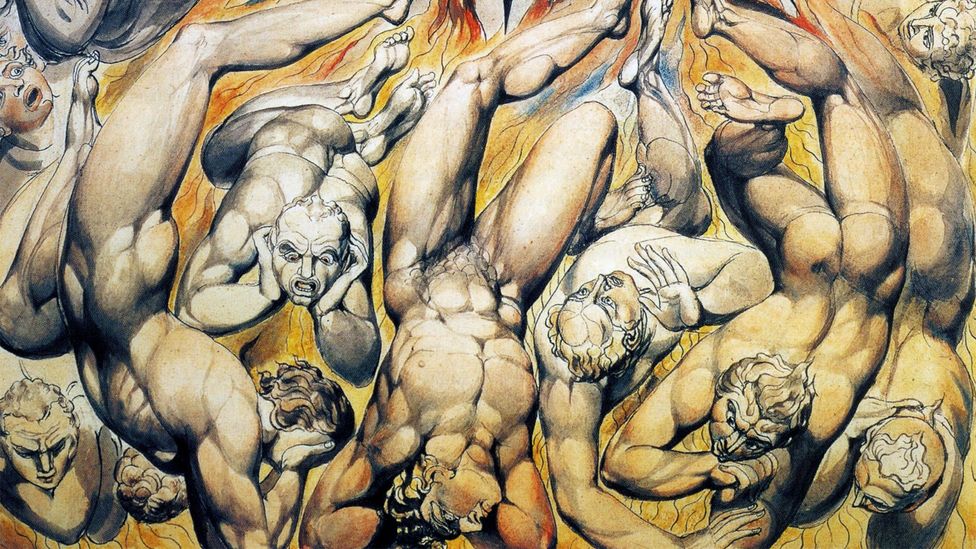
The greatest epic verse form in the English language linguistic communication, John Milton's Paradise Lost, has divided critics – only its influence on English literature is second simply to Shakespeare's, writes Benjamin Ramm.
M
Milton's Paradise Lost is rarely read today. But this epic poem, 350 years old this month, remains a piece of work of unparalleled imaginative genius that shapes English literature even at present.
In more than 10,000 lines of blank verse, it tells the story of the war for heaven and of man'south expulsion from Eden. Its dozen sections are an aggressive attempt to cover the loss of paradise – from the perspectives of the fallen angel Satan and of human, fallen from grace. Fifty-fifty to readers in a secular age, the poem is a powerful meditation on rebellion, longing and the desire for redemption.
Despite being born into prosperity, Milton's worldview was forged past personal and political struggle. A committed republican, he rose to public prominence in the ferment of England's bloody ceremonious state of war: ii months afterwards the execution of Rex Charles I in 1649, Milton became a diplomat for the new republic, with the title of Secretary for Foreign Tongues. (He wrote verse in English, Greek, Latin and Italian, prose in Dutch, German, French and Spanish, and read Hebrew, Aramaic and Syriac).
Milton gained a reputation in Europe for his erudition and rhetorical prowess in defence of England'due south radical new regime; at home he came to be regarded as a prolific abet for the Democracy cause. Only his deteriorating eyesight limited his diplomatic travels. Past 1654, Milton was completely blind. For the final 20 years of his life, he would dictate his poetry, messages and polemical tracts to a serial of amanuenses – his daughters, friends and fellow poets.
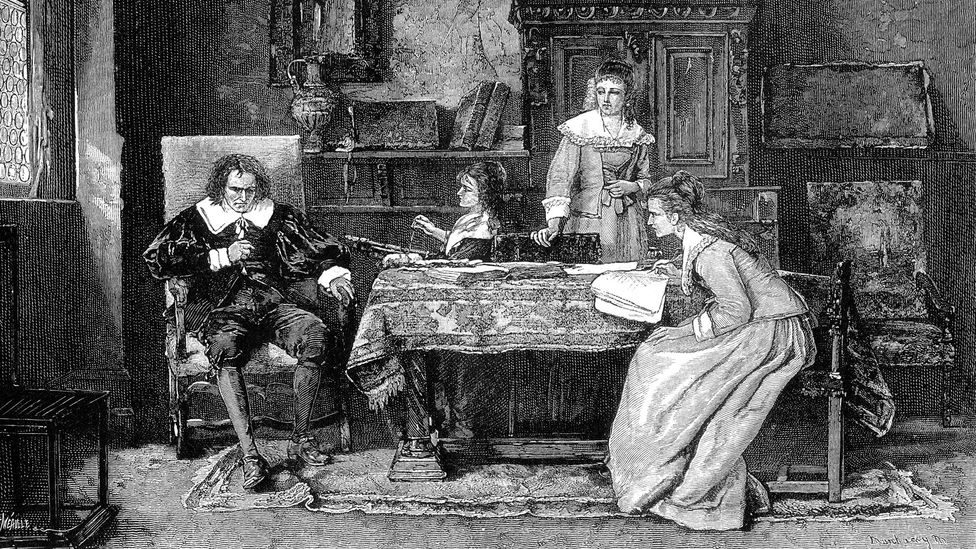
Milton is shown dictating Paradise Lost to his daughters in this engraving after a painting by Michael Munkacsy (Credit: Alamy)
In Paradise Lost, Milton draws on the classical Greek tradition to conjure the spirits of blind prophets. He invokes Homer, author of the first peachy epics in Western literature, and Tiresias, the oracle of Thebes who sees in his mind'southward centre what the physical heart cannot. As the philosopher Descartes wrote during Milton'due south lifetime, "it is the soul which sees, and not the eye". William Blake, the most brilliant interpreter of Milton, later wrote of how "the Eye of Imagination" saw beyond the narrow confines of "Single vision", creating works that outlasted "mortal vegetated Eyes".
Clever devil
When Milton began Paradise Lost in 1658, he was in mourning. It was a year of public and private grief, marked past the deaths of his second wife, memorialised in his beautiful Sonnet 23, and of England's Lord Protector, Oliver Cromwell, which precipitated the gradual disintegration of the republic. Paradise Lost is an attempt to brand sense of a fallen world: to "justify the ways of God to men", and no doubt to Milton himself.
But these biographical aspects should not downplay the centrality of theology to the poem. As the critic Christopher Ricks wrote of Paradise Lost, "Fine art for art'south sake? Art for God's sake". 1 reason why Milton is read less at present is that his religious lexicon – which sought to explain a 'fallen' world – itself has fallen from use. Milton the Puritan spent his life engaged in theological disputation on subjects as diverse as toleration, divorce and salvation.
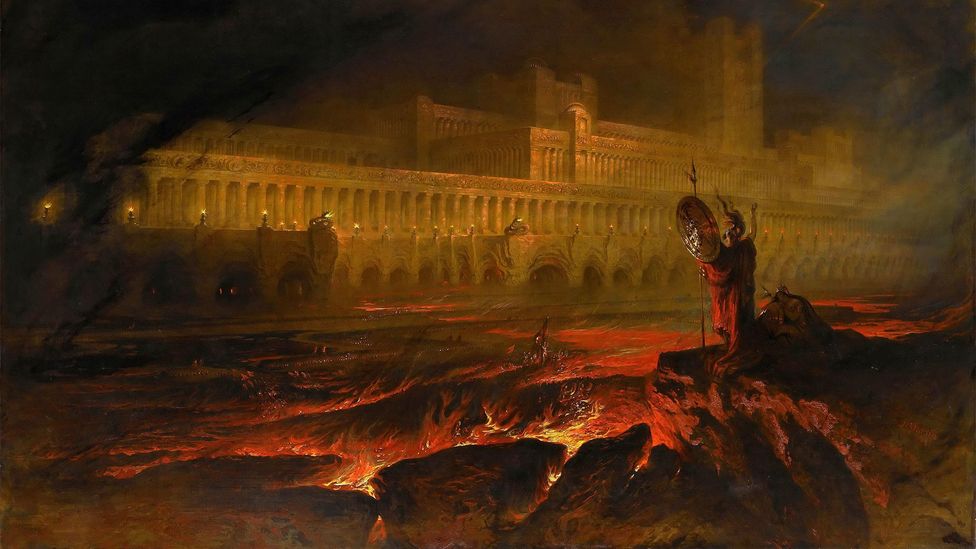
John Martin'due south 1825 painting depicts Pandemonium, the capital letter of Hell in Paradise Lost (Credit: Alamy)
The verse form begins with Satan, the "Traitor Angel", cast into hell after rebelling against his creator, God. Refusing to submit to what he calls "the Tyranny of Heaven", Satan seeks revenge by tempting into sin God's precious creation: man. Milton gives a vivid account of "Man'due south First Defiance" before offering a guide to salvation.
Ricks notes that Paradise Lost is "a trigger-happy argument about God's justice" and that Milton's God has been accounted inflexible and cruel. By contrast, Satan has a dark charisma ("he pleased the ear") and a revolutionary demand for self-determination. His speech is peppered with the language of democratic governance ("costless choice", "total consent", "the popular vote") – and he famously declares, "Amend to reign in Hell, than serve in Heaven". Satan rejects God's "splendid vassalage", seeking to live:
Gratis, and to none accountable, preferring
Hard liberty earlier the easy yoke
Of servile Pomp.
Nonconformist, anti-establishment writers such every bit Percy Shelley found a kindred spirit in this delineation of Satan ("Milton'due south Devil as a moral being is… far superior to his God", he wrote). Famously, William Blake, who contested the very idea of the Fall, remarked that "The reason Milton wrote in fetters when he wrote of Angels & God, and at freedom when of Devils & Hell, is considering he was a truthful Poet and of the Devil'due south party without knowing it".
Like Cromwell, Milton believed his mission was to usher in the kingdom of God on earth. While he loathed the concept of the 'divine right of kings', Milton was willing to submit himself to God in the belief, in Benjamin Franklin's words, that "Rebellion to Tyrants Is Obedience to God".
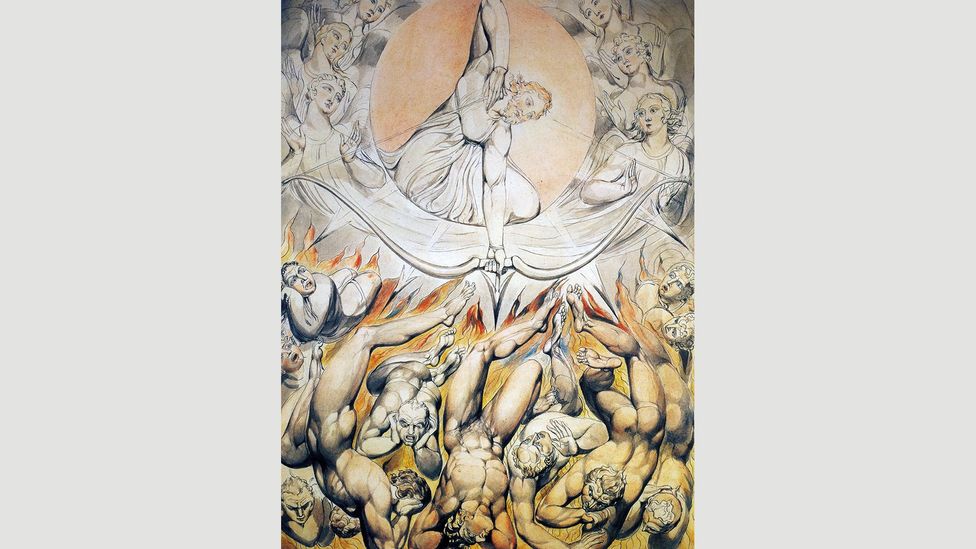
William Blake, who called Milton 'a true Poet', produced several sets of illustrations for Paradise Lost in the early 19th Century (Credit: Alamy)
Although give-and-take of Paradise Lost oft is dominated by political and theological arguments, the poem also contains a tender celebration of dear. In Milton's version, Eve surrenders to temptation in office to be closer to Adam, "the more than to depict his love". She wishes for the liberty to err ("What is faith, love, virtue unassayed?"). When she does succumb, Adam chooses to join her: "to lose thee were to lose myself", he says:
How tin I live without yous, how forgo
Thy sweet antipodal and love so dearly joined,
To alive over again in these wild woods forlorn?
Should God create some other Eve, and I
Some other rib afford, yet loss of thee
Would never from my heart.
Canon fodder
When Paradise Lost was published in London in 1667, Milton had fallen out of favour. Just months earlier the restoration of the Stuart monarchy in May 1660, he had published a pamphlet denouncing kingship. At present Milton was scorned, his writings were burned, and he was imprisoned in the Tower of London – simply narrowly escaping execution subsequently the intercession of a fellow poet, Andrew Marvell.
Even so Paradise Lost gained firsthand acclaim even among royalists. The poet laureate John Dryden reworked Milton's epic, casting Cromwell – a regicide with dictatorial tendencies – in the part of Satan. Samuel Johnson ranked Paradise Lost among the highest "productions of the human mind".
Romantic writers celebrated Milton both for his opinion confronting censorship ("Give me the liberty to know, to utter, and to argue freely co-ordinate to censor", Milton wrote in the pamphlet Areopagitica), and for his innovative poetic form, which was suggestive, allusive and free from what he called "the troublesome and modern chains of rhyming". Paradise Lost inspired Mary Shelley's Frankenstein, while Wordsworth began his famous sonnet London, 1802 with a plea: "Milton! thou shouldst be living at this 60 minutes: England hath need of thee".
But not all critics were then favourable. The 20th Century brought united states of america the 'Milton Controversy', during which his legacy was fiercely contested. His detractors included poets TS Eliot and Ezra Pound (who wrote that "Milton is the worst sort of poison"), while support came from both devout Christians (like CS Lewis) and atheists (including William Empson, for whom "The reason why the poem is so adept is that it makes God so bad"). Malcolm X read Paradise Lost in prison, sympathising with Satan, while AE Housman quipped that "malt does more than Milton can / To reconcile God'due south means to man".
In recent years, Paradise Lost has establish new admirers. Milton is "our greatest public poet", says author Philip Pullman, whose acclaimed trilogy His Nighttime Materials was inspired by the poem (and takes its title from Book 2, line 916). Pullman loves Milton's audacity – his declaration that he will create "Things unattempted withal in Prose or Rhyme" – and his musicality: "No one, not even Shakespeare, surpasses Milton in his command of the sound, the music, the weight and gustation and texture of English words". Pullman has declared: "I am of the Devil's political party and know it".
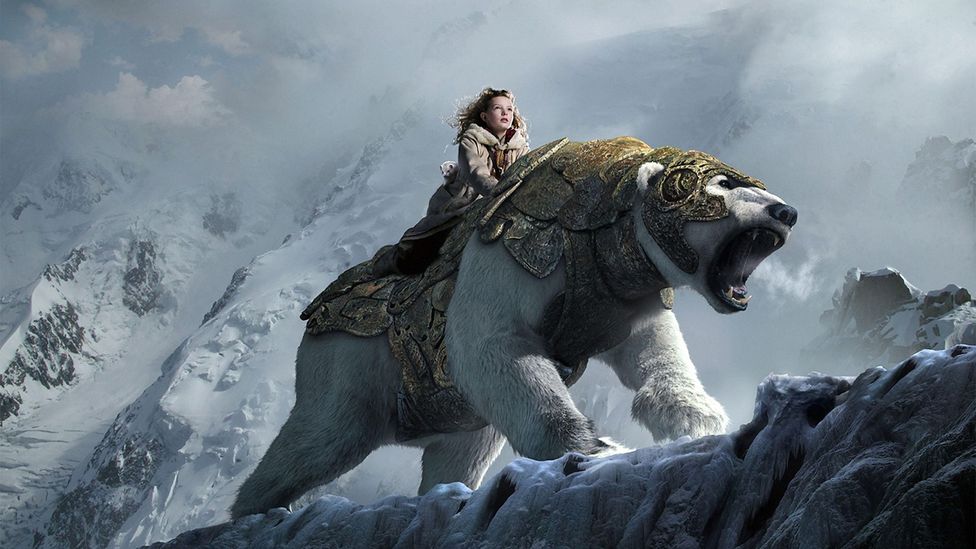
Philip Pullman's His Dark Materials takes its name from Paradise Lost; the first volume in the trilogy, The Gilt Compass, was turned into a movie in 2007 (Credit: Alamy)
Milton'due south enemies regarded his blindness equally divine retribution, but his condition enhanced his acute musical sensibility. Pullman is enchanted by the verse form's "incantatory quality", and implores readers to experience it aurally: "Rolling swells and peels of sound, powerful rhythms and rich harmonies… that very grade casts a spell". Paradise Lost makes an excellent sound book.
Information technology is said that Milton had fevered dreams during the writing of Paradise Lost and would wake with whole passages formulated in his mind. The starting time time I read the poem, I did then in a unmarried sitting, overnight – like Jacob wrestling with the Angel until morning time. Each re-reading brings intoxication, exhilaration and exhaustion, and vindicates Milton's observation: "The heed is its own identify, and in itself / Can make a Heaven of Hell, a Hell of Sky."
This story is a part of BBC United kingdom of great britain and northern ireland – a series focused on exploring this extraordinary isle, one story at a time. Readers outside of the Uk tin can run into every BBC U.k. story past heading to the Uk homepage ; y'all also can see our latest stories by following u.s.a. on Facebook and Twitter .
If you would similar to annotate on this story or anything else you accept seen on BBC Civilisation, head over to our Facebook folio or bulletin us on Twitter .
And if you liked this story,sign up for the weekly bbc.com features newsletter, chosen "If You Only Read half dozen Things This Calendar week". A handpicked selection of stories from BBC Future, Earth, Civilisation, Capital letter, Travel and Autos, delivered to your inbox every Friday.
Source: https://www.bbc.com/culture/article/20170419-why-paradise-lost-is-one-of-the-worlds-most-important-poems
0 Response to "Poem Make a Bridge to Heaven and Bring You Back Home Again"
Enviar um comentário