What Is a Desighn That Looks Like Spin Art
It is highly unlikely that you lot or I will ever exist wealthy enough to acquire a piece of art from Damien Hirst. The provocative British artist, who first made a splash in the 1990s for formaldehyde-filled-tank sculptures occupied by preserved animals, is ane of the globe'due south near successful living artists, with works sold in the tens of millions of dollars.
Now, in a new partnership with Snap (Fast Visitor'south Nearly Innovative Visitor of 2020), Hirst is bringing one of his most iconic motifs to the platform—and enabling you to make your own. An interactive tool to make your own Hirst spin painting is launching today to raise money for Partners in Health, a nonprofit focused on healthcare access for everyone.
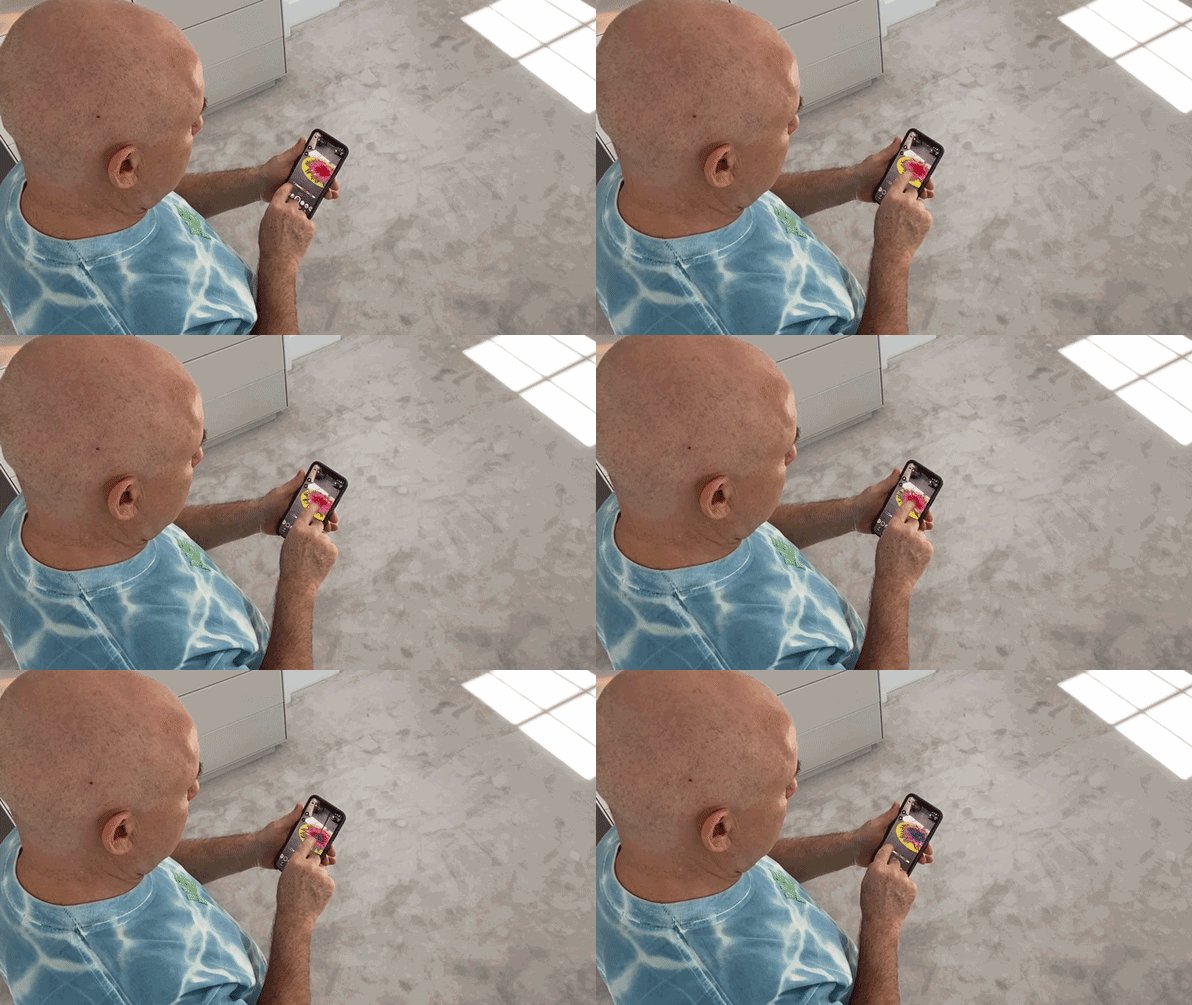
Hirst debuted his spin paintings in 1992 during a gallery bear witness. He rigged upwardly a round plate atop a drill. And for the low price of £one, visitors were allowed to toss on paint to create swirling abstract works that he and artist Angus Fairhurst would then sign.
"The way that I looked at spin art [was] . . . every bit an creative person, you sit in a studio with a bare canvass and a tortured soul. The blank canvas is actually intimidating," says Hirst. "With spin art, if you go something moving betwixt you and art, you get fine art without the angst."
Hirst saw spin art, with its colorful splashes that sit somewhere between tie-dye and Jackson Pollock, as a democratic approach to painting. "Everyone can make a good one," he says.
To this day, Hirst has a spin art rig gear up upwardly in his studio, and he's invited many people to make their own over the years. Snap CEO Evan Spiegel himself visited the studio, and sometime thereafter, Hirst agreed to interact with Snap on something around the 2020 Cannes festival.
These artist partnerships are relatively mutual for Snap, as the company explores the future of augmented reality. With 75% of Snap's 229 million daily active users trying its AR tools out every 24-hour interval, Snap has brought AR mainstream in a fourth dimension when most of the tech industry is still debating how and when such a future could come. Snap sells AR ads, of course, and the engagement of these products is off the charts. Yet, as cofounder Bobby White potato put it to me late terminal twelvemonth, he and Spiegel know there'south a lot still to explore about what AR will exist—and cocky-expression serves equally the anchor. "If you said to me, 'The only thing AR will ever corporeality to was this beautiful new style to experience someone else'due south imagination through your ain eyes,' that would be plenty for us!"
Snap leverages artist partnerships to push its own boundaries and strength its own development team to think nigh its technologies in new ways. In 2017, Snap teamed up with Jeff Koons to build giant, augmented reality balloon dogs subconscious across the world. And over the past two years, Snap has worked with Christian Marclay, Alex Israel, and Harmony Korine on experimental projects, debuting these collaborations as installations to make a splash at Cannes and Art Basel.
Hirst's Snapchat Spin Art would exist debuting at the Cannes Film Festival this June, had the festival not been canceled due to COVID-xix. In any case, after he agreed to the project, Snap adult a prototype for Hirst's Spin Art, then shared the project with Hirst for feedback.
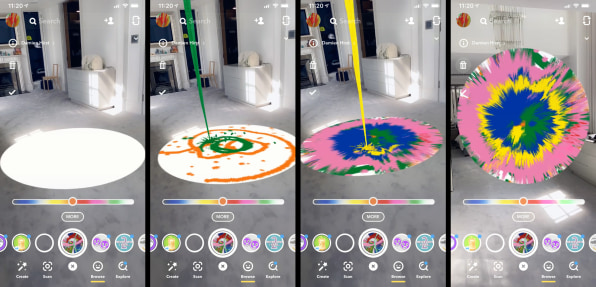
Hirst thought the basics of the interface were right—y'all tap and drag your finger to splash paint onto the canvas. But he suggested some tweaking regarding the canvas'southward spin speed and even its thickness. He also requested more colors. Snap had proposed 4 in the demo, but Hirst—having used Snapchat quite a scrap with his own kids—knew that Snap could bring in a broader range of colors to choose from, and so he suggested that. He also wanted black and white options, because the ii-tone spin paintings are some of his favorites, he says.
The one thing he couldn't decide was if the pigment should really splash off the canvas and all over the rest of your view in Snapchat. "I want to make it feel similar life," he says. "[Spin fine art] throws off more than paint than it keeps on." But ultimately, he decided that a clean approach, in which the actress paint merely disappeared, was ameliorate.
The Spin Art filter launches on Snap today—you should find information technology as an option in the photo filter carousel. After selecting the filter, you tin drag the canvas wherever you'd like information technology to appear in your room. Hirst suggests that children are the best at it, "well-nigh like a viewer of their ain work," while "control freaks" will find themselves frustrated if they don't assent to the randomness. And whenever you're done working on your masterpiece, you can swipe upward to brand a donation to Partners in Health.
Read on for an abridged transcript of the residuum of our interview with Damien Hirst.
Fast Visitor: How did you get started working with Snap?
Damien Hirst: Evan visited my studio, that'southward the first coming together I had. Merely plainly I've been using Snapchat previously as a way to go along in contact with my kids. Whenever I text them, they don't respond. And on Snapchat for some reason they go dorsum to me. Somewhere, in the dorsum of my listen, I was thinking [this partnership] is gonna be good for my kids.
FC: What about spin paintings appealed to you?
DH: I did a evidence with my friend Angus. We were both dressed like clowns. I gave people an option to purchase my spin paintings—I did that for a pound. I made some, hung them on the walls, sold them, put prices on them. I ever invited people to make their own.
FC: Is in that location a difference between a spin painting yous make and one someone else makes?
DH: It's a funny thing. I had an assistant paint spots for me. When they left, they wanted me to give them a spot painting. I said, "Why don't yous brand your own? The only departure betwixt one by me and one by you is the money." And they say, "I'll never sell it!" I say, "No no, you make one, and it's a souvenir from me." They say, "No, I desire you to sign it!" It's a funny concept, of where the art ends . . .
FC: This is a abiding debate, right? Because in your studio, you don't literally put every pigment to the canvas of your art.
DH: I come across it like an architect—you wouldn't pay a premium if you had a Frank Gehry business firm, and he put downwards the bricks.
I want to cleave a chair from marble; I don't have the time to go for 15 years to learn how to exist a marble carver for one object. It's non like I'one thousand going to carry on carving marble. I want my art to compete with everything in the globe, to be able to exist influenced by and cross-referenced.
Very quickly, you have the skills needed [to be an artist]; you just have to use the ones you've got. As an artist, a lot of people don't like that. You could almost say, charge a premium for paintings fabricated by me, only they're all made by me!
FC: So, if I make a spin painting in Snapchat, does that hateful I can telephone call it a Damien Hirst?
DH: Yeah, of course. I'll sign information technology for you lot! [laughs]
FC: I practise see a parallel, in artists having administration to execute a vision, and of all the assistive digital tools we accept today, like Photoshop.
DH: It's infinite, isn't information technology? It'due south something that's been around for a long fourth dimension. I remember someone at an opening came up to me. I hadn't met them. They said, "Wow, you're Damien Hirst! Information technology's and then smashing you're an artist!" I said, "Don't tell anybody, but I'm not really an artist."
They were like, "What? Don't tell me that!" I'grand just joking, but it's a career equally well. Damien Hirst Creative person [is] on the passport, but the idea is it's something deeper. [Information technology's an ideology] you lot can't trick people or be in it for the coin; you accept to be in it for the art. [People] have a huge conventionalities in artists for some reason.
Information technology's a powerful thing. I believe in art like you believe in religion, but it's funny, how the idea that you lot don't make your own paintings 100% can be a niggling chip of an event. But no artist ever has. [This issue] only happens in art; information technology doesn't happen in whatever other area. Anyone working anything. Chefs in a kitchen—you don't mind that anybody else preps the food for y'all.
FC: So much of your art is about facing death and bloodshed caput-on. Do yous need these works in a earth where nosotros already face so much death? Doesn't that message just go superseded by the global pandemic?
DH: It always does. You tin't forget art is a kind of leisure activeness. You've gotta have food on the table in club to enjoy art. There are basic human needs. If they aren't met, you don't have time for art. Even primitive art! People were living in caves earlier there were cavern paintings, but at some point in that location's plenty fourth dimension going around that they think, "We can make our cave a picayune bit better."
It'southward overnice to do these charity things, because y'all realize, even though this is going on, you tin give something. People volition requite money to become a footling scrap of art. I call back without life . . . there is no art. But without art in that location is withal life. I think life'southward more of import than fine art, is what I would say.
FC: Any last advice on making spin paintings?
DH: I recollect the secret is knowing when to stop.
Source: https://www.fastcompany.com/90499358/unleash-your-inner-damien-hirst-with-snapchats-new-filter
0 Response to "What Is a Desighn That Looks Like Spin Art"
Enviar um comentário