Can You Plant Iris Bulbs in the Spring
| Iris | |
|---|---|
 | |
| Iris sibirica | |
Scientific nomenclature  | |
| Kingdom: | Plantae |
| Clade: | Tracheophytes |
| Clade: | Angiosperms |
| Clade: | Monocots |
| Order: | Asparagales |
| Family unit: | Iridaceae |
| Subfamily: | Iridoideae |
| Tribe: | Irideae |
| Genus: | Iris L., 1753 |
| Type species | |
| Iris germanica L. | |
| Subgenera | |
| Hermodactyloides | |
| Synonyms | |
| Belamcanda | |
Iris is a genus of 260–300[1] [2] species of flowering plants with showy flowers. It takes its name from the Greek discussion for a rainbow, which is also the proper noun for the Greek goddess of the rainbow, Iris. Some authors country that the name refers to the broad multifariousness of blossom colors plant among the many species.[3] Equally well equally beingness the scientific proper noun, iris is also widely used equally a common name for all Iris species, likewise as some belonging to other closely related genera. A mutual name for some species is 'flags', while the plants of the subgenus Scorpiris are widely known as 'junos', particularly in horticulture. It is a pop garden bloom.
The frequently-segregated, monotypic genera Belamcanda (blackberry lily, I. domestica), Hermodactylus (snake's head iris, I. tuberosa), and Pardanthopsis (vesper iris, I. dichotoma) are currently included in Iris.
Three Iris varieties are used in the Iris blossom data set outlined by Ronald Fisher in his 1936 paper The use of multiple measurements in taxonomic problems equally an example of linear discriminant analysis.[4]
Description [edit]
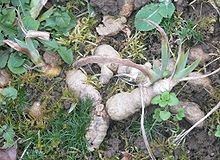
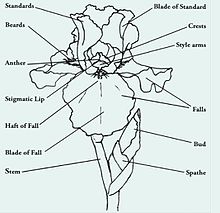
Illustration of an iris flower with highlighted parts of the flower
Irises are perennial plants, growing from creeping rhizomes (rhizomatous irises) or, in drier climates, from bulbs (bulbous irises). They have long, erect flowering stems which may be unproblematic or branched, solid or hollow, and flattened or have a round cross-department. The rhizomatous species unremarkably have 3–10 basal sword-shaped leaves growing in dense clumps. The bulbous species have cylindrical, basal leaves.[ commendation needed ]
Flower [edit]
The inflorescences are in the shape of a fan and comprise 1 or more than symmetrical six-lobed flowers. These grow on a pedicel or peduncle. The 3 sepals,[5] which are usually spreading or droop down, are referred to as "falls". They expand from their narrow base (the "claw" or "haft"[6]), into a broader expanded portion ("limb" or "bract"[seven]) and tin can be adorned with veining, lines or dots. In the center of the blade, some of the rhizomatous irises have a "beard" (a tuft of brusk upright extensions growing in its midline),[eight] which are the plant'southward filaments.[9] [ better source needed ]
The three,[v] sometimes reduced, petals stand upright, partly behind the sepal bases. They are called "standards". Some smaller iris species have all half dozen lobes pointing straight outwards, but by and large limb and standards differ markedly in appearance. They are united at their base into a floral tube that lies above the ovary (known as an epigynous or inferior ovary). The three styles[five] divide towards the noon into petaloid branches; this is significant in pollination.[ citation needed ]
The iris flower is of involvement as an case of the relation betwixt flowering plants and pollinating insects. The shape of the flower and the position of the pollen-receiving and stigmatic surfaces on the outer petals form a landing-stage for a flying insect, which in probing for nectar, will kickoff come into contact with the perianth, and so with the three[five] stigmatic stamens in one whorled surface which is borne on an ovary formed of three carpels. The shelf-like transverse projection on the inner whorled underside of the stamens is beneath the overarching style arm beneath the stigma, so that the insect comes in contact with its pollen-covered surface only afterwards passing the stigma; in backing out of the bloom it will come in contact only with the not-receptive lower face of the stigma. Thus, an insect begetting pollen from ane blossom will, in inbound a 2nd, deposit the pollen on the stigma; in backing out of a flower, the pollen which it bears will not exist rubbed off on the stigma of the same flower.[10]
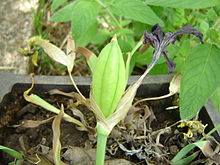
The iris fruit is a capsule which opens up in iii parts to reveal the numerous seeds inside. In some species, the seeds bear an aril. Such as Iris stolonifera which equally lite brown seeds that take thick white aril (or coatings).[11]
Taxonomy [edit]
Iris is the largest genus of the family Iridaceae with up to 300 species – many of them natural hybrids.[12] Mod classifications, starting with Dykes (1913), accept subdivided them. Dykes referred to the major subgroupings every bit sections. Subsequent authors such as Lawrence (1953) and Rodionenko (1987) accept generally chosen them subgenera, while essentially retaining Dykes' groupings, using six subgenera further divided into twelve sections. Of these, section Limneris (subgenus Limneris) was further divided into sixteen series. Similar some older sources, Rodionenko moved some of the bulbous subgenera (Xiphium, Scorpiris and Hermodactyloides) into separate genera (Xiphion, Juno and Iridodictyum respectively), simply this has not been accepted by later writers such every bit Mathew (1989), although the latter kept Hermodactylus every bit a distinct genus, to include Hermodactylus tuberosus, now returned to Hermodactyloides as Iris tuberosa.[12]
Rodionenko besides reduced the number of sections in subgenus Iris, from six to two, depending on the presence (Hexapogon) or absence (Iris) of arils on the seeds, referred to as arilate or nonarilate. Taylor (1976) provides arguments for not including all arilate species in Hexapogon.[12]
In general, modern classifications usually recognise 6 subgenera, of which five are restricted to the Old Globe; the 6th (subgenus Limniris) has a Holarctic distribution. The two largest subgenera are further divided into sections. The Iris subgenus has been divided into half-dozen sections; bearded irises (or pogon irises), Psammiris, Oncocyclus, Regelia, Hexapogon and Pseudoregelia.[thirteen] Iris subg. Limniris has been divided into two sections; Lophiris (or 'Evansias' or crested iris) and Limniris which was farther divided into 16 series.[14]
Subgeneric division [edit]
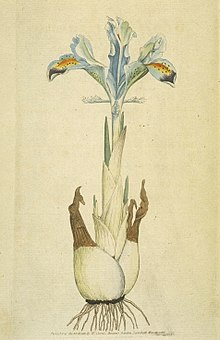
A member of subgenus Scorpiris: Iris persica, a bulbous iris

Subgenera [edit]
- Iris (Bearded rhizomatous irises)
- Limniris (Beardless rhizomatous irises)
- Xiphium (Smooth-bulbed bulbous irises: Formerly genus Xiphion)
- Nepalensis (Bulbous irises: Formerly genus Junopsis)
- Scorpiris (Smooth-bulbed bulbous irises: Formerly genus Juno)
- Hermodactyloides (Reticulate-bulbed bulbous irises: Formerly genus Iridodictyum)
Sections, serial and species [edit]
Distribution and habitat [edit]


Well-nigh all species are found in temperate Northern hemisphere zones, from Europe to Asia and across N America. Although diverse in ecology, Iris is predominantly constitute in dry, semi-desert, or colder rocky mountainous areas.[12] Other habitats include grassy slopes, meadowlands, bogs and riverbanks.[ citation needed ]
Cultivation [edit]

Iris is extensively grown as ornamental plant in abode and botanical gardens. Presby Memorial Iris Gardens in New Bailiwick of jersey, for case, is a living iris museum with over 10,000 plants, while in Europe the most famous iris garden is arguably the Giardino dell'Iris in Florence (Italia) which every twelvemonth hosts a well attended iris breeders' competition. Irises, particularly the multitude of bearded types, feature regularly in shows such equally the Chelsea Flower Evidence.
For garden cultivation, iris nomenclature differs from taxonomic classification. Garden iris are classed as either bulb iris or rhizome iris (chosen rhizomatous) with a number of farther subdivisions. Due to a wide variety of geographic origins, and thus bully genetic diversity, cultivation needs of iris vary profoundly.
Iris grow well in most any garden soil types providing they are well-drained. The earliest to flower are species like I. junonia and I. reichenbachii, which flower as early on as February and March in the Northern Hemisphere, followed past the dwarf forms of I. pumila, and so past nearly of the tall bearded varieties, such every bit the German iris and its variety florentina, sweet iris, Hungarian iris, lemon-xanthous iris (I. flavescens), Iris sambucina, I. amoena, and their natural and horticultural hybrids such as those described under names like I. neglecta or I. squalens and best united under I. × lurida.
The iris is promoted in the Britain by the British Iris Society.[15] The national collection of Arthur Bliss Irises is held in Gloucestershire.[16]
Disguised rhizome iris [edit]

'Amethyst Flame'. Note prominent "beard".
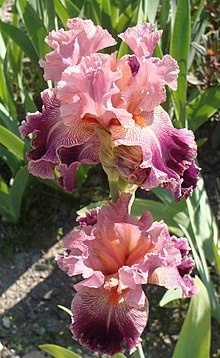
Tall Bearded Iris 'Barocco'
Bearded iris are classified as dwarf, alpine, or aril. In Europe, the most commonly found garden iris is a hybrid iris (falsely chosen German iris, I. germanica which is sterile) and its numerous cultivars. Diverse wild forms (including Iris aphylla)[17] and naturally occurring hybrids of the Sweet iris (I. pallida) and the Hungarian iris (I. variegata) class the basis of almost all modern hybrid bearded irises. Median forms of bearded iris (intermediate bearded, or IB; miniature alpine disguised, or MTB; etc.) are derived from crosses between tall and dwarf species like Iris pumila.
Bearded iris are easy to cultivate and propagate and take become very popular in gardens. A pocket-size selection is usually held by garden centres at appropriate times during the season, just there are thousands of cultivars bachelor from specialist suppliers (more than 30 000 cultivars only for the tall bearded irises !). They are all-time planted every bit blank root plants in late summer, in a sunny open position with the rhizome visible on the surface of the soil and facing the dominicus. They should be divided in summer every two or iii years, when the clumps become congested.
A truly red disguised iris, like a truly blue rose, remains an unattained goal despite frequent hybridizing and selection. There are species and selections, most notably based on the beardless rhizomatous Copper iris (I. fulva), which accept a relatively pure red color. However, getting this color into a modern disguised iris breed has proven very difficult, and thus, the vast majority of irises are in the purple and blueish range of the color spectrum, with xanthous, pink, orangish and white breeds also available.
AGM cultivars [edit]
The post-obit is a selection of bearded irises that take gained the Royal Horticultural Society's Award of Garden Merit:
- 'Alizes'[eighteen] (tall bearded, bluish & white)
- 'Bumblebee Deelite'[19] (miniature tall bearded, yellowish/purple)
- 'Early on Light'[xx] (tall bearded, pale yellow)
- 'Jane Phillips'[21] (tall bearded, stake blueish)
- 'Langport Wren'[22] (intermediate bearded, maroon)
- 'Maui Moonlight'[23] (intermediate bearded, stake yellow)
- 'Orinoco Menstruum'[24] (edge disguised, white/violet)
- 'Raspberry Blush'[25] (intermediate bearded, pink)
- 'Sarah Taylor'[26] (dwarf bearded, pale yellow)
- 'Thornbird'[27] (alpine bearded, pale yellow)
- 'Titan's Glory'[28] (tall bearded, deep blue)
Bearded iris Oncocyclus section [edit]
This section contains the cushion irises or royal irises, a group of plants noted for their big, strongly marked flowers. Between thirty and 60 species are classified in this department, depending on the authority. Species of section Oncocyclus are generally strict endemics, typically occurring in a small-scale number of scattered, disjunct populations, whose geographical isolation is enhanced by their pollination strategy and myrmecochory seed dispersal. Morphological deviation between populations unremarkably follows a cline reflecting local adaptation to environment conditions; furthermore, this largely overlaps deviation between species, making it difficult to identify discrete species boundaries in these irises.[29] [30] Compared with other irises the absorber varieties are scantily furnished with narrow sickle-shaped leaves and the flowers are normally borne singly on the stalks; they are often very dark and in some almost blackish.[31] The cushion irises are somewhat fastidious growers, and to be successful with them they must be planted rather shallow in very gritty well-tuckered soil. They should non be disturbed in the fall, and afterward the leaves have withered the roots should be protected from heavy rains until growth starts again naturally.
Bearded iris Regelia section [edit]
This section, closely allied to the absorber irises, includes several garden hybrids with species in department Oncocyclus, known every bit Regelio-cyclus irises. They are best planted in September or October in warm sunny positions, the rhizomes existence lifted the post-obit July after the leaves have withered.
Beardless rhizome iris (subgenus Limniris) [edit]
There are six major subgroupings of the beardless iris, depending on origin. They are divided into Pacific Declension, Siberica, Spuria, Louisiana, Japanese, and other.
Beardless rhizomatous iris types ordinarily plant in the European garden are the Siberian iris (I. sibirica) and its hybrids, and the Japanese Iris (I. ensata) and its hybrids. "Japanese iris" is also a catch-all term for the Japanese iris proper (hanashōbu), the blood iris (I. sanguinea, ayame) and the rabbit-ear iris (I. laevigata, kakitsubata). I. unguicularis is a late-wintertime-flowering species from Algeria, with sky-blue flowers with a yellow streak in the centre of each petal, produced from Winter to Spring. Yet another beardless rhizomatous iris pop in gardening is I. ruthenica, which has much the same requirements and characteristics as the tall bearded irises. In North America, Louisiana iris and its hybrids are often cultivated.
Crested rhizome iris (subgenus Limniris) [edit]
One specific species, Iris cristata from North America.
Bulbing juno iris (subgenus Scorpiris) [edit]
Ofttimes called 'junos', this type of iris is i of the more popular seedling irises in cultivation. They are generally earliest to bloom.
Bulbing European iris (subgenus Xiphium) [edit]
This group includes irises generally of European descent, and are besides classified equally Dutch, English, or Spanish iris.
- Iris reticulata and Iris persica, both of which are fragrant, are also popular with florists.
- Iris xiphium, the Castilian Iris (also known equally Dutch Iris) and
- Iris latifolia, the English Iris. Despite the common names both the Spanish and English iris are of Spanish origin, and have very showy flowers, and then they are popular with gardeners and florists. They are among the hardier bulbous irises, and can be grown in northern Europe. They require to be planted in thoroughly drained beds in very light open soil, moderately enriched, and should have a rather sheltered position. Both these present a long series of cute varieties of the virtually various colours, flowering in May, June and July, the smaller Spanish iris being the earlier of the two.
Bulbing reticulate iris (subgenus Hermodactyloides) [edit]
Reticulate irises with their characteristic bulbs, including the yellow I. danfordiae, and the various blue-imperial I. histrioides and I. reticulata, flower as early as Feb and March. These reticulate-bulbed irises are miniatures and pop spring bulbs, being 1 of the showtime to bloom in the garden. Many of the smaller species of bulbous iris, beingness liable to perish from backlog of moisture, should have a well-drained bed of proficient but porous soil made up for them, in some sunny spot, and in winter should be protected by a covering of half-decayed leaves or fresh coco-fiber.
Gallery [edit]
-
-

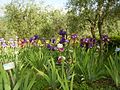
Disguised iris cultivar, similar to the archetype/historical cultivar 'Alcazar'
-

Chestnut iris cultivars like 'Samurai Warrior' are the closest that breeders have been able to attain to a red bearded iris
-

-

Iris 'Katharine Hodginkin', a bulbous cultivar being a hybrid of I. winogradowii and I. histrioides 'Major'
-
-

-

-

Iris ensata 'Blue Beauty'
-
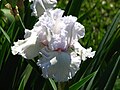
Iris 'Queen of Angels'
-

Iris 'Blatant'
-
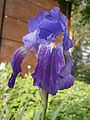
Iris germanica, an one-time and vigorous cultivar that requires minimal civilization
-

Iris 'Mrs. Andris', a vigorous, historic, tall bearded iris cultivar that Fryer hybridized in 1919
-

-

Uses [edit]
Aromatic rhizomes [edit]

Bombay Sapphire gin contains flavoring derived from particular bearded iris species Iris germanica and Iris pallida.
Rhizomes of the German Iris (I. germanica) and Sweetness Iris (I. pallida) are traded as orris root and are used in perfume and medicine, though more common in ancient times than today. Today Iris essential oil (accented) from flowers are sometimes used in aromatherapy as allaying medicines. The stale rhizomes are also given whole to babies to assist in teething. Gin brands such as Mumbai Sapphire and Magellan Gin use orris root and sometimes iris flowers for flavor and color.[32] [33]
For orris root production, iris rhizomes are harvested, dried, and aged for upward to 5 years. In this time, the fats and oils inside the roots undergo degradation and oxidation, which produces many fragrant compounds that are valuable in perfumery. The scent is said to be similar to violets. The aged rhizomes are steam-distilled which produces a thick oily chemical compound, known in the perfume industry as "iris butter" or orris oil.[ citation needed ]
Iris rhizomes too comprise notable amounts of terpenes, and organic acids such as ascorbic acid, myristic acid, tridecylenic acid and undecylenic acrid. Iris rhizomes tin be toxic. Larger bluish flag (I. versicolor) and other species often grown in gardens and widely hybridized incorporate elevated amounts of the toxic glycoside iridin. These rhizomes can crusade nausea, airsickness, diarrhea, and/or skin irritation, simply poisonings are not normally fatal. Irises should only be used medicinally under professional guidance.[ commendation needed ]
Water purification [edit]
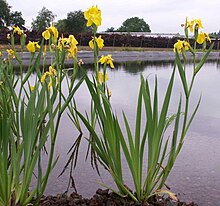
In water purification, yellow iris (I. pseudacorus) is often used. The roots are unremarkably planted in a substrate (e.g. lava-stone) in a reedbed-setup. The roots then meliorate water quality past consuming nutrient pollutants, such as from agricultural runoff. This highly aggressive grower is now considered a noxious weed and banned in some states of the U.s. where it is found clogging natural waterways.[ commendation needed ]
In civilisation [edit]
The Iris is one of the flowers listed as nascence bloom for Feb.[34] In Christianity, the iris represents Our Lady of Sorrows as its abrupt leaves are like swords.[35]
The Iris croatica is the unofficial National Flower of Croatia .[36] Iris nigricans, the Black Iris is the national blossom of Jordan.[37] Iris bismarckiana, the Nazareth Iris, is the symbol of the city of Upper Nazareth.[38] [39]
In 1998, Iris lacustris, the Dwarf Lake Iris was designated the state wildflower of Michigan,[40] [41] where the vast majority of populations exist.[42]
In 1990, the Louisiana iris was voted the state wildflower of Louisiana,[43] though the country blossom is the magnolia blossom.[44]
In Islamic republic of iran and Kashmir,[45] Iris kashmiriana and Iris germanica [46] are well-nigh commonly grown on Muslim[14] grave yards.[47] [48] [49]
An iris — species unspecified — is ane of the country flowers of Tennessee. Information technology is more often than not accepted that the species Iris versicolor, the Majestic Iris is the land blossom[50] aslope the wild-growing purple passionflower (Passiflora incarnata), the state's other floral emblem. Greeneville, Tennessee, is abode to the almanac Iris Festival celebrating the iris, local customs, and culture.[51] The species Iris versicolor is also the provincial flower of Quebec, having replaced the Madonna lily which is not native to the province.[52] and it is the official flower of Kappa Pi International Honorary Art Fraternity.[53]
The artist George Gessert has specialised in convenance irises.[54]

The artist Vincent van Gogh painted several famous pictures of irises.[55]
The American creative person Joseph Mason – a friend of John James Audubon – painted a precise paradigm of what was then known as the Louisiana flag or copper iris (Iris fulva), to which Audubon after added two Northern paraula birds (Parula americana) for inclusion as Plate 15 in his Birds of America.
The artist Philip Hermogenes Calderon painted an iris in his 1856 piece of work Cleaved Vows; he followed the principles of the Pre-Raphaelite Alliance. An aboriginal conventionalities is that the iris serves as a warning to be heeded, every bit information technology was named for the messenger of Olympus. It also conveys images of lost dear and silent grief, for young girls were led into the afterlife by Iris. Cleaved Vows was accompanied with poetry by Henry Wadsworth Longfellow when information technology was outset exhibited.[56]
French King Clovis I (466–511), when he converted to Christianity, changed his symbol on his banner from 3 toads to irises (the Virgin'due south bloom).[57]
The fleur-de-lis, a stylized iris, first occurs in its mod use as the keepsake of the Firm of Capet. The fleur-de-lis has been associated with French republic since Louis VII adopted it as a symbol in the 12th century. The yellow fleur-de-lis reflects the yellowish iris (I. pseudacorus), common in Western Europe. Contemporary uses can exist seen in the Quebec flag and the logo of the New Orleans Saints professional football team and on the flag of Saint Louis, Missouri.
The reddish fleur-de-lis in the coat-of-arms and flag of Florence, Italia, descends from the white iris which is native to Florence and which grew even in its city walls. This white iris displayed against a red groundwork was the symbol of Florence until the Medici family reversed the colors to signal a alter in political power, setting in motion a centuries-long and still on-going convenance program to hybridize a red iris.
The fleur-de-lis is the near-universal symbol of Scouting and ane of the symbols adopted by the sorority Kappa Kappa Gamma.
A stylized yellow iris is the symbol of Brussels, since historically the of import Saint Gaugericus Island was carpeted in them.[58] The iris symbol is now the sole feature on the flag of the Brussels-Capital Region. The provincial bloom of Québec (Canada) is the harlequin blueflag (I. versicolor), called iris versicolore in French.
It is thought in Red china, that Iris anguifuga has the ability to proceed snakes from inbound the garden. It grows all winter, keeping snakes out, but then goes dormant in the jump, assuasive the snakes back into the garden. In the autumn, the iris re-appears and tin stop the snakes again.[59] [60]
In the Homeric Hymn to Demeter, the goddess Persephone and her companion nymphs (the Oceanids forth with Artemis and Athena) were gathering flowers such as rose, crocus, violet, iris (also called 'agallis' or ἀγαλλίς (in Greek script),[61] lily, larkspur,[62] and hyacinth[63] in a springtime meadow earlier she was abducted past the god Hades.[62]
It has been suggested that the 'agallis' mentioned was a dwarf iris, as described by leaf and root shape,[64]) and identified as Iris attica.[65] [66]
Gallery [edit]
-

Glaze-of-arms of Florence
-

-

-

Stylized Lily used in heraldry
See also [edit]
- American Iris Order
- Banshu Yamasaki Iris Garden
References [edit]
- ^ "WCSP: Iris". Earth Checklist of Selected Found Families . Retrieved ii June 2014.
- ^ "Iris". Pacific Bulb Gild. 2011-11-26. Retrieved 2012-03-03 .
- ^ Manning, John; Goldblatt, Peter (2008). The Iris Family: Natural History & Nomenclature. Portland, Oregon: Timber Press. pp. 200–204. ISBN978-0-88192-897-6.
- ^ R. A. Fisher (1936). "The utilize of multiple measurements in taxonomic problems" (PDF). Annals of Eugenics. 7 (two): 179–188. doi:x.1111/j.1469-1809.1936.tb02137.ten. hdl:2440/15227. Archived from the original (PDF) on 2011-04-12. Retrieved 2015-08-30 .
- ^ a b c d Taylor, Ronald J. (1994) [1992]. Sagebrush Land: A Wildflower Sanctuary (rev. ed.). Missoula, MT: Mountain Printing Pub. Co. p. 72. ISBN0-87842-280-three. OCLC 25708726.
- ^ "Parts of an Iris Flower". merlebleu. Archived from the original on 2016-03-04. Retrieved 28 August 2015.
- ^ Donald Wyman Wyman's Gardening Encyclopedia, p. 574, at Google Books
- ^ Lorraine HarrisonLatin for Gardeners: Over three,000 Plant Names Explained and Explored, p. 141, at Google Books
- ^ "The Beauty and Office of the Iris Bloom". wordpress.com. 2011-04-03. Retrieved 28 August 2015.
- ^ Pat Willmer Pollination and Floral Ecology, p. 78, at Google Books
- ^ Simonet, Marc; Werckmeister, Peter (25 January 1965). "A Cytogenetic and Descriptive Study of the Trispecific Iris Hybrid 'Stolorine' Werckmeister". Caryologia. 18 (two): 291–303. doi:ten.1080/00087114.1965.10796173.
- ^ a b c d Rina Kamenetsky; Hiroshi Okubo, eds. (2012). "Iridaceae". Ornamental Geophytes: From Basic Science to Sustainable Production. CRC Press. p. 24. ISBN978-1-4398-4924-8.
- ^ "The Genus Iris". mathcs.clarku.edu . Retrieved 29 July 2021.
- ^ a b Stebbings, Geoff (1997). The Gardener's Guide to Growing Irises . Newton Abbot: David and Charles. p. 23. ISBN978-0715305393.
- ^ https://www.britishirissociety.org.uk/
- ^ https://www.blissiris.co.uk/
- ^ Austin, Claire (2005). Irises; A Garden Encyclopedia. Timber Printing. p. 124. ISBN978-0881927306.
- ^ "RHS Plant Selector – Iris 'Alizes'". Royal Horticultural Society. Retrieved 22 September 2020.
- ^ "RHS Found Selector – Iris 'Bumblebee Deelite'". Royal Horticultural Society. Retrieved 22 September 2020.
- ^ "RHS Plant Selector – Iris 'Early on Light'". Royal Horticultural Order. Retrieved 22 September 2020.
- ^ "RHS Plant Selector – Iris 'Jane Phillips'". Royal Horticultural Order. Retrieved 22 September 2020.
- ^ "RHS Plant Selector – Iris 'Langport Wren'". Majestic Horticultural Society. Retrieved 22 September 2020.
- ^ "RHS Establish Selector – Iris 'Maui Moonlight'". Royal Horticultural Society. Retrieved 22 September 2020.
- ^ "RHS Plant Selector – Iris 'Orinoco Flow'". Purple Horticultural Society. Retrieved 22 September 2020.
- ^ "RHS Constitute Selector – Iris 'Raspberry Chroma'". Royal Horticultural Society. Retrieved 22 September 2020.
- ^ "RHS Constitute Selector – Iris 'Sarah Taylor'". Purple Horticultural Society. Retrieved 22 September 2020.
- ^ "RHS Establish Selector – Iris 'Thornbird'". Imperial Horticultural Guild. Retrieved 22 September 2020.
- ^ "RHS Plant Selector – Iris 'Titan'due south Glory'". Royal Horticultural Society. Retrieved 22 September 2020.
- ^ Sapir, Y.; Shmida, A. Species concepts and ecogeographical deviation of Oncocyclus irises. Israel J. Plant Sci. 2002, 50, 119–127
- ^ Abdel Samad, N.; Bou Dagher-Kharrat, M.; Hidalgo, O.; El Zein, R.; Douaihy, B.; Siljak-Yakovlev, S. Unlocking the karyological and cytogenetic variety of Iris from Lebanese republic: Oncocyclus section shows a distinctive contour and relative stasis during its continental radiation. PLOS ONE 2016, 15, 11:e0160816. DOI 10.1371/periodical.pone.0160816
- ^ Wilson, Ballad A.; Padiernos, Justin; Sapir, Yuval (February 2016). "The royal irises (Iris subg. Iris sect. Oncocyclus): Plastid and depression-copy nuclear data contribute to an understanding of their phylogenetic relationships". Taxon. 65 (1): 35–46. doi:x.12705/651.3. Retrieved 4 Jan 2018.
- ^ Kathi Keville The Aromatherapy Garden: Growing Fragrant Plants for Happiness and Well-Being, p. 397, at Google Books
- ^ "Magellan Gin". theginisin.com. 2011-01-29. Retrieved 29 May 2018.
- ^ "Birth Month Flower of February - The Iris". 1st in Flowers!.
- ^ Kostka, Arun Oswin. "Flowers in Christian Symbolism".
- ^ James Minahan The Consummate Guide to National Symbols and Emblems (2 Volumes), p. 364, at Google Books
- ^ "Wildlife and Vegetation". kinghussein.gov.jo. Government of Jordan. Retrieved 2015-05-10 .
- ^ Rinat, Zafrir (11 September 2006). "Circumspection, Iris Ahead!". haaretz.com. Retrieved 25 July 2016.
- ^ Alon TalAll the Trees of the Forest: Israel'south Woodlands from the Bible to the Present, p. 260, at Google Books
- ^ "Iris lacustris Nutt". michiganflora.cyberspace. Archived from the original on 5 March 2016. Retrieved ix April 2015.
- ^ "Michigan State Wildflower". Netstate.com. Retrieved 2012-05-xiv .
- ^ "Michigan Natural Features Inventory" (PDF). Archived from the original (PDF) on 2011-09-29. Retrieved 2012-05-14 .
- ^ Charlotte Seidenberg (1 March 1993). The New Orleans Garden: Gardening in the Gulf Due south. Univ. Printing of Mississippi. p. 223. ISBN978-0-87805-637-8.
- ^ "Louisiana Land Wildflower". statesymbolsusa.org. Retrieved 28 Nov 2014.
- ^ "Chapter I Rhizomatous Iris (part 2)". irisbotanique.over-weblog.com. Retrieved 20 Oct 2015.
- ^ Singh, Gurcharan. "Kashmir Iris". flowersofindia.net. Retrieved 22 Oct 2015.
- ^ British Iris Gild (1997) A Guide to Species Irises: Their Identification and Tillage, p. 38-39, at Google Books
- ^ Austin, Claire (2005). Irises; A Garden Encyclopedia. Timber Press. ISBN978-0881927306.
- ^ Trak, Touseef Hussain; Upadhayay, Ravi (Apr 2015). "Ethnobotanical And Taxonomic Study Of Members of Iridaceae Family of Kishtwar, (Jammu And Kashmir) Bharat" (PDF). International Periodical of Pharma and Bio Sciences. 6 (2): 779–793. Archived from the original (PDF) on 2016-08-02. Retrieved 22 Oct 2015.
- ^ "State of Tennessee". land.tn.united states of america.
- ^ "18th Annual Iris Festival". Greenecountypartnership.com. Archived from the original on 2012-03-15. Retrieved 2012-03-03 .
- ^ (in French) Gouvernement du Québec Emblèmes du Québec - Iris versicolor Archived 2015-07-21 at the Wayback Machine
- ^ Article I, Section 2. "International Constitution of Kappa Pi" (PDF). Kappa Pi International Honorary Fine art Fraternity Inc. [ permanent dead link ]
- ^ West [2008]
- ^ Pioch (2002)
- ^ Mancoff (2003): pp. 6, xvi
- ^ Margaret Grieve A Modern Herbal, Volume ii (1971), p. 435, at Google Books
- ^ Chancery of the Prime number Government minister, Kingdom of Belgium [2007]
- ^ "Species and H2o Garden Iris". iriscitygardens.com. Retrieved xix January 2015.
- ^ Kramb, D. (14 September 2004). "Iris anguifuga". signa.org (Species Iris Group of North America). Retrieved 19 Jan 2015.
- ^ "ἀγαλλίς". lsj.translatum.gr. Retrieved 10 September 2015.
- ^ a b "Flora 1, Plants of Greek Myth". theoi.com. Retrieved ix September 2015.
- ^ R. P. Winnington-Ingram Sophocles: An Interpretation (1980), p. 116, at Google Books
- ^ Leonhard Schmitz (Editor) The Classical Museum: A Journal of Philology, and of Ancient History and literature, Volume 5 (1848), p. 60, at Google Books
- ^ "Tag Archives: British Iris Society". wiebkerost.com. Retrieved 10 September 2015.
- ^ Umberto Quattrocchi CRC World Lexicon of Medicinal and Poisonous Plants: Common Names, Scientific names, Synonyms and Etymology (2012, p. 128, at Google Books
Bibliography [edit]
- Chancery of the Prime Minister, Kingdom of Belgium (2007): Brussels Town Hall. Retrieved November 11, 2007.
- Kamenetsky, Rina; Okubo, Hiroshi, eds. (2012). "Iridaceae". Ornamental Geophytes: From Bones Science to Sustainable Product. CRC Press. p. 24. ISBN978-1-4398-4924-eight.
- Mancoff, Debra Northward (2003). Flora Symbolica: Flowers in Pre-Raphaelite Art. New York: Prestel Publishing. ISBN3-7913-2851-4.
- Pioch, Nicolas (2002). Gogh, Vincent van: Irises . Retrieved December 10, 2008.
- Species Grouping of the British Iris Society (1996). A Guide to Species Irises: Their Identification and Cultivation. Cambridge: Cambridge University Press. ISBN0-521-44074-2.
- Due west, Ruth (2008). "George Gessert". Archived from the original on 2006-05-16. Retrieved December ten, 2008. [ dead link ]
Taxonomy [edit]
- Baker, John Gilbert (2012). "Systematic Handling of the Genus Iris". American Iris Society.
- Dykes, William Rickatson (1913). The Genus Iris. Cambridge: Cambridge University Press. ISBN0486230376.
- Harris, Gwenda (2011). "Nomenclature of Irises" (PDF). New Zealand Iris Guild. Archived from the original (PDF) on 2018-01-27.
- Mathew, Brian (1989). The Iris. London: BT Batsford. ISBN978-0713460391.
- Lawrence, George Hill Mathewson (1953). "A Reclassification of the Genus Iris". Gentes Herbarum. 8: 346–371.
- Rodionenko, GI (1987). The Genus Iris L. (Questions of Morphology, Biology, Evolution and Systematics). London: British Iris Club. ISBN9780901483300. (translation)
- Taylor, JJ (1976). "A reclassification of Iris species bearing arillate seeds". Proceedings of the Biological Lodge of Washington. 89: 411–420.
- Wilson, Carol (2004). Phylogeny of the genus Iris based on Deoxyribonucleic acid sequence data. Rancho Santa Ana Botanic Garden. Archived from the original on 2014-06-02. [ dead link ]
External links [edit]
- Joseph Stonemason'southward painting - Copper Iris Copper Iris / Louisiana Flag (Iris cuprea) from John James Audubon's Birds of America
- Flora of North America: Iris
- Flora of China: Iris
- Flora of Pakistan: Iris
- Flora of Nepal: Iris
- A web site devoted to Irises, by David Payne-Joyce; includes plates from Dykes (1913).
- The American Iris Guild
- Celebrated Iris Preservation Guild
- An extensive website about Iris
- Iris listings at Wild Flowers of State of israel
- Iris in Fine art and Culture
- Gouvernement du Québec Emblèmes du Québec - Iris versicolor Archived 2015-07-21 at the Wayback Machine (French)
Source: https://en.wikipedia.org/wiki/Iris_(plant)
0 Response to "Can You Plant Iris Bulbs in the Spring"
Enviar um comentário